7 Agentic AI Use Cases in Healthcare for 2026
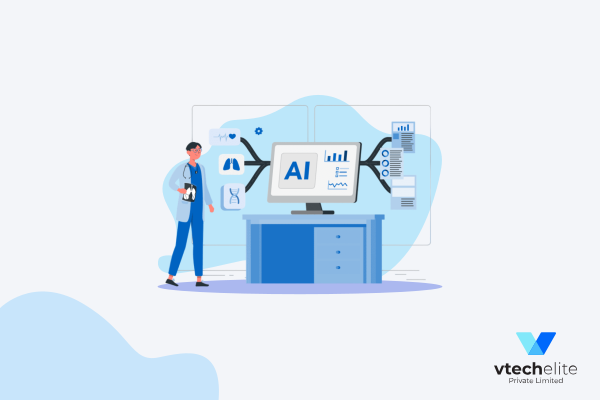



7 Agentic AI Use Cases in Healthcare for 2026
The healthcare industry is entering a transformative era where artificial intelligence is evolving from a passive assistant into an active collaborator. By 2026, we will see the widespread integration of Agentic AI, a new generation of autonomous and decision-capable AI systems that will become the backbone of critical healthcare functions.
These advanced systems are set to be at the core of improving diagnostic accuracy, personalizing patient care, and streamlining hospital operations.
This blog explores the top 7 Agentic AI Use Cases in Healthcare, revealing how these autonomous AI agents are fundamentally changing the landscape of medical science. We will discuss their profound impact on critical areas such as diagnostic precision, personalized treatment strategies, and advanced genomics.
As experts with years of experience navigating the complexities of AI integration , we understand the immense potential and the inherent challenges of this transformative technology.
What Is Agentic AI in Healthcare?
Agentic AI represents a significant paradigm shift, moving beyond traditional AI models that primarily assist human experts by providing insights. These advanced systems are engineered to act with a degree of independence, operating autonomously within carefully predefined safety and ethical boundaries.
In the high-stakes environment of healthcare, this distinction is crucial. Agentic AI agents are designed to do more than just predict outcomes; they can reason through complex scenarios, make context-driven decisions based on evolving patient data.
Agentic AI applications in healthcare integrate perception, reasoning, and action to streamline medical processes. It understands complex data, draws clinical conclusions, and triggers next steps, like scheduling scans or alerting clinicians. This advanced approach makes it more effective than rule-based or machine-learning-only systems, offering greater adaptability and decision-making capabilities
By adding these smart systems to hospital workflows, doctors can quickly turn data into action, saving time and lives.
Why Agentic AI is Transforming Healthcare in 2026
By 2026, Agentic AI is set to transform healthcare for several key reasons. Underlying technologies including large language models (LLMs), reinforcement learning, and computer vision are now mature and accessible, making widespread deployment feasible. At the same time, immense pressure on global healthcare systems from aging populations and rising costs demands solutions that can boost efficiency.
Agentic AI directly addresses these challenges. It automates administrative and diagnostic burdens, freeing clinicians to focus on patient interaction and complex reasoning. For instance, an AI agent can handle the entire preauthorization process with insurance companies, a notoriously time-consuming task.
These systems also analyze vast datasets beyond human capacity, unlocking personalized medicine and predictive health. By 2026, evolving regulatory frameworks will offer clearer pathways for AI system approval and integration.
This convergence of technology readiness, urgent need, and regulatory clarity positions Agentic AI as a cornerstone of modern healthcare. Organizations exploring this technology today will be best positioned to lead this transformation. For those looking to get ahead, working with an AI Agent Services provider offers a strategic advantage.
How Agentic AI Systems Work in Healthcare
Agentic AI systems work through a structured cycle :
Perception :
- This step involves collecting and interpreting data from diverse sources. It's not just about scanning static records; it includes dynamic data from Electronic Health Records (EHRs), real-time sensor readings from wearables, complex medical imaging (like MRIs and CTs), and intricate genomic sequencing results. The agent's ability to perceive these varied data streams is foundational to its intelligence.
Reasoning :
- Once perceived, the data undergoes sophisticated reasoning. Agentic AI leverages vast clinical knowledge, probabilistic inference, and strict ethical guidelines to weigh possibilities. This process generates actionable, contextually relevant insights, moving beyond simple data aggregation to true understanding.
Action :
- Based on its reasoning, the agent acts directly or recommends actions to human counterparts. For example, it might automatically alert a physician to a patient's critical change, adjust a ventilator based on real time feedback, or trigger a diagnostic workflow for specific tests, all to optimize patient outcomes.
Learning :
- Agentic AI systems are not static. They continuously refine their capabilities through a rigorous learning process, adapting based on the outcomes of their actions and feedback from clinicians and data. This iterative enhancement ensures they become increasingly proficient and accurate over time.
- This approach allows AI agents in healthcare use cases to do much more than just chatbots or data analysis. They become like digital teammates, helping with every part of patient care.
Top 7 Agentic AI Use Cases in Healthcare (2026)
As agentic AI advances, it’s applications transform the healthcare industry. Here are seven key agentic AI use cases set to shape healthcare by 2026.
1. Automated Medical Imaging & Diagnostics
- By 2026, we anticipate a profound transformation in radiology and pathology, driven by full-fledged agentic automation. This means that AI agents will not merely assist, but actively and autonomously analyze complex medical imaging.
- They will meticulously scrutinize MRI, CT, and X-ray scans, comparing their findings against vast historical datasets to identify subtle patterns and anomalies.
- This sophisticated analysis will culminate in the generation of detailed preliminary diagnostic reports, significantly streamlining the initial stages of patient evaluation.
Instead of waiting for a human radiologist to initiate analysis, these agents proactively :
- Flag potential abnormalities
- Suggest subsequent diagnostic actions
- Prioritize critical cases in emergency workflows
Agentic AI automatically identifying early-stage lung nodules during a routine scan, instantly alerting clinicians. The result: faster diagnosis, earlier treatment, and improved patient outcomes.
2. Clinical Decision Support Systems (CDSS)
- Traditional AI decision-support tools are built on preprogrammed models, which operate within fixed parameters and cannot adapt beyond their initial programming. In contrast, Agentic AI in healthcare use cases introduces intelligent agents that go beyond static models.
- These agents learn continuously from real-world clinical outcomes, allowing them to refine their understanding and improve over time. Unlike traditional systems, they adapt dynamically in real time, responding to changing conditions and evolving patient needs.
By 2026, agentic CDSS will :
- Analyze patient data across departments
- Generate tailored treatment recommendations
- Justify each decision with transparent reasoning
These systems will serve as “AI copilots” for clinicians, synthesizing data, identifying risks, and helping doctors make faster, evidence based decisions. Doctors stay in control while the AI manages the cognitive load.
3. Patient Engagement & Virtual Health Assistants
- Patient care doesn't just happen within the hospital's walls; it's a continuous journey. Agentic AI is set to redefine how patients engage with their healthcare providers outside of the clinical setting.
- Traditional virtual health assistants are evolving from simple chatbots into sophisticated, autonomous health agents. These advanced systems are capable of adapting in real time to a patient's changing health status and needs, providing a new layer of dynamic support.
By 2026, these systems will :
- Engage patients with personalized recommendations
- Monitor wearable data
- Proactively detect anomalies and alert caregivers
Consider a heart disease patient: their smartwatch vitals are analyzed by an agent, irregularities detected, and a teleconsultation scheduled automatically. This paradigm shift from reactive to proactive care ensures continuous, context-aware support.
4. Medicine & Genomics
- Genomic data is incredibly complex, vast, and continuously evolving, making it challenging to analyze and interpret effectively. Agentic AI introduces scalability and advanced intelligence to this dynamic field, enabling more efficient and comprehensive genomic analysis.
- By leveraging autonomous AI agents, researchers can mine countless research papers, uncover critical mutations, and even predict potential treatment paths with greater precision.
By 2026, agentic ai applications in healthcare will accelerate precision medicine through :
- AI-driven genetic mapping for individualized therapies
- Automated discovery of novel drug molecules
- Predictive modeling for hereditary diseases
In pharmaceutical R&D, these agents simulate drug interactions in silico, cutting costs and speeding up time-to-market. The fusion of genomics and AI will make personalized medicine the global standard.
5. Predictive Analytics for Disease Outbreaks
- The pandemic underscored the critical importance of preparedness within healthcare systems, highlighting the need for proactive measures to ensure resilience. Agentic AI provides a powerful solution by enabling continuous global surveillance through the integration of multi-layered data.
- This includes tracking hospital admissions to monitor healthcare capacity, analyzing environmental conditions to identify potential health risks, and evaluating population health metrics to detect emerging trends.
By 2026, agentic agents will act autonomously :
- Predict regional disease outbreaks.
- Model public health responses.
- Suggest containment and vaccination strategies.
Imagine a spike in respiratory symptoms across regions. An AI agent could instantly identify emerging viral trends and alert authorities. This early-warning system transforms how nations manage public health crises.
6. Autonomous Medical Research Assistants
- Medical research, a cornerstone of scientific advancement, traditionally demands extensive manual data review, meticulous clinical trial matching, and comprehensive literature synthesis. This labor-intensive process, as any seasoned researcher knows, can often be a bottleneck to progress.
- Here, Agentic AI emerges as a transformative force, accelerating discovery by automating these foundational, yet time-consuming, tasks. These intelligent agents are engineered to autonomously review and synthesize insights from thousands upon thousands of studies, extracting critical information with unparalleled efficiency.
By 2026, researchers will rely on these agents for :
- Real-time evidence synthesis
- Clinical trial design optimization
- Continuous learning from biomedical data
This democratizes innovation, enabling smaller research teams to compete with global labs and shortening the time from discovery to deployment.
7. Hospital Operations Management
- Operational inefficiencies are a massive drain on healthcare resources, costing hospitals billions of dollars each year. Agentic AI offers a solution by introducing self-optimizing operational ecosystems.
Think of these as intelligent, autonomous systems designed to streamline hospital management. These AI agents work behind the scenes to autonomously manage complex and interconnected tasks, such as :
- Staff scheduling and shift rotations
- Bed allocation and patient flow
- Predictive maintenance of equipment
- Supply chain forecasting
By 2026, hospitals will use AI orchestration systems that operate 24/7, adjusting workflows dynamically. For instance, if patient inflow surges unexpectedly, the AI reallocates staff, preps rooms, and manages inventory, all without human prompting. The result is a smarter, leaner, patient centric healthcare environment.
Benefits of Agentic AI in Healthcare
Agentic AI is redefining what efficiency and quality mean in modern medicine. Instead of replacing professionals, these intelligent systems act as reliable partners that make healthcare smarter, faster, and more human centered.
One of the most visible benefits is time liberation. Doctors and nurses spend less energy on administrative overload, like entering data, reviewing reports, or tracking test results, and more on what truly matters: patient care. Imagine a clinician walking into every appointment with instant insights already summarized by an AI assistant. That extra focus can make the difference between good and exceptional care.
Accuracy and safety also reach new levels. Agentic AI never tires, forgets, or overlooks details. It continuously monitors patient data, cross checks medications, and spots patterns invisible to the human eye. Early warnings about health risks allow intervention before complications arise, turning treatment from reactive to proactive.
For patients, the experience becomes more personal and responsive. AI agents learn preferences, communication styles, and health goals, ensuring care plans feel tailored rather than generic. Whether it is reminding someone to take their medication or scheduling a follow up automatically, these small touches create a sense of continuous care and reassurance.
Hospitals benefit too. Smarter resource allocation, reduced delays, and fewer errors translate into measurable savings without compromising quality. But beyond numbers, the true value lies in renewed human connection, a healthcare system where professionals have more time to listen, patients feel genuinely cared for, and technology quietly empowers both.
VtechElite’s Role in the Agentic AI Revolution
VtechElite is at the forefront of driving innovation in Agentic AI for healthcare, empowering organizations to integrate intelligent, autonomous systems that enhance efficiency and patient care.
With deep expertise in AI development, AI Consulting Services, and healthcare solutions, VtechElite helps hospitals and research institutions implement secure, ethical, and scalable AI-driven applications. Through tailored strategies, advanced analytics, and continuous support, the company ensures seamless adoption of next-generation technologies.
By bridging the gap between human expertise and intelligent automation, VtechElite enables healthcare providers to deliver more precise, proactive, and patient-centered care in the era of Agentic AI.
Conclusion
By 2026, healthcare will have crossed a monumental threshold, from algorithmic assistance to autonomous intelligence. Agentic AI systems will not replace clinicians but redefine their roles, empowering them to deliver care that is faster, more precise, and deeply personalized.
These Agentic AI Use Cases in Healthcare demonstrate how intelligent agents can act as collaborators rather than mere tools. From predictive analytics to virtual assistants and robotic surgery, the potential impact is immense. However, success will depend on three pillars: ethics, explainability, and integration. Healthcare organizations must ensure that every autonomous decision is transparent, traceable, and patient centric.
As hospitals, researchers, and technology companies align under this vision, AI in healthcare will evolve into a dynamic ecosystem of intelligent, responsible, and self learning systems. The organizations that act today and Hire Dedicated AI Developers will lead tomorrow, transforming healthcare into a proactive, data driven, and compassionate enterprise powered by Agentic AI.
Frequently Asked Questions (FAQ's)
You might also like
14 Of The Hottest Mobile Application Development Trends You Should Know This Year
Differences Between No-code, Low-code, and High-code Development

Top Ecommerce development trends to watch out for in 2023
What Our Customers Say About Us

