Generative AI vs Predictive AI: What’s the Difference?
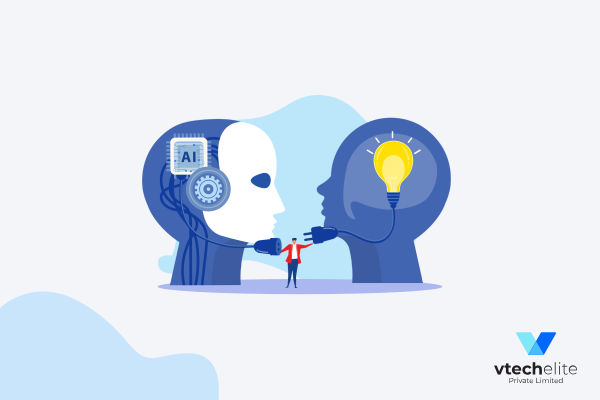



Table of contents
Generative AI vs Predictive AI: What’s the Difference?
Artificial Intelligence AI has become one of the most important technologies in the modern world helping machines perform tasks that normally require human intelligence. AI is widely used in areas like smart assistants, recommendation systems, business automation and data analysis making everyday processes faster and more efficient.
Among different types of AI Generative AI and Predictive AI are the most commonly discussed because they serve completely different purposes. Generative AI is designed to create new content such as text images, audio and video by learning patterns from large datasets. It is used in tools like ChatGPT and image generators.
On the other hand Predictive AI focuses on analyzing past data to predict future outcomes such as customer behavior, weather forecasts or financial trends.
In simple terms Generative AI is about creation while Predictive AI is about prediction. Understanding generative ai vs predictive ai helps us see how both technologies are shaping the future in different but powerful ways.
What is Artificial Intelligence (AI)?
Artificial Intelligence (AI) is the ability of machines to imitate human intelligence and perform tasks such as learning, reasoning, problem-solving, and decision-making. It is used in many daily applications that make life easier and faster.
AI can be divided into different types with generative systems and predictive systems being the most important. Generative AI creates new content, while predictive AI analyzes data to forecast outcomes.
This difference is often discussed when studying types of AI generative vs predictive in modern machine learning. AI is widely used in voice assistants, recommendation systems, search engines, and fraud detection, making it an essential part of everyday technology.
What is Generative AI?
Generative AI is a type of artificial intelligence designed to create new and original content based on patterns learned from large datasets. Traditional systems that only analyze or classify data, generative models produce entirely new outputs.
How Generative AI Works
- Generative AI works by studying large amounts of data such as text, images, or audio to understand patterns, structures, and relationships. During training, it learns how humans write, speak, or create visuals. After learning, it uses this knowledge to generate new and original content that looks similar to real data.
- For example, text models can produce human-like answers, while image models can create realistic pictures. Tools like ChatGPT and diffusion models use this process to generate useful and creative outputs.
Key Technologies Behind Generative AI
- Large Language Models (LLMs)
- Generative Adversarial Networks (GANs)
- Diffusion Models
- Transformer Architectures
These technologies allow AI systems to generate realistic and creative outputs.
Use Cases of Generative AI
- Content writing and blogging
- Image and video creation
- Code generation
- Marketing automation
- Product design
Businesses increasingly rely on tools powered by Generative AI Development Services to build custom AI solutions for content creation and automation.
What is Predictive AI?
Predictive AI focuses on analyzing historical and real-time data to forecast future outcomes. It identifies patterns, trends, and relationships within data to predict what is likely to happen next. It does not create new content but helps organizations make informed decisions based on data-driven forecasts.
How Predictive AI Works
- Predictive AI uses machine learning models trained on historical datasets. It analyzes past data to identify patterns, trends, and relationships that can help forecast future outcomes. By learning from previous events, it can estimate what is likely to happen next.
- For example, businesses use Predictive AI to forecast sales, predict customer behavior, and detect fraudulent transactions, helping them make more informed decisions.
Key Technologies Behind Predictive AI
- Machine Learning algorithms
- Regression models
- Classification models
- Time-series forecasting
- Statistical modeling
Predictive systems are often integrated into enterprise platforms through AI Integration Services, enabling businesses to make data-driven decisions efficiently.
Use Cases of Predictive AI
- Risk analysis in banking
- Weather forecasting
- Healthcare diagnosis prediction
- Inventory and demand forecasting
- Customer behavior analysis
Key differences between Generative AI and Predictive AI
The core difference between both lies in purpose and output.
| Feature | Generative AI | Predictive AI |
|---|---|---|
| Purpose | Creates new content | Predicts future outcomes |
| Output | Text, images, audio, video | Forecasts, probabilities |
| Data Type | Large unstructured data | Structured historical data |
| Goal | Creativity & generation | Accuracy & prediction |
| Example | ChatGPT, Midjourney | Fraud detection, forecasting tools |
This comparison clearly highlights what is the difference between generative and predictive ai in practical terms. Both technologies serve different but equally important roles in AI ecosystems.
Advantages and Limitations
Generative AI
- High creativity and automation
- Fast content generation
- Supports multiple formats (text, image, video)
- Enhances productivity
- Can generate inaccurate information
- High computational cost
- Requires large datasets
- May produce biased outputs
Predictive AI
- High accuracy in forecasting
- Supports data-driven decisions
- Reduces business risks
- Efficient in structured environments
- Limited creativity
- Depends heavily on historical data
- Cannot generate new content
- May fail in unpredictable scenarios
Real-World Applications of Generative AI
Generative AI is widely used across many industries to improve creativity, productivity, and automation. In marketing and advertising, it helps create engaging ads, social media posts, and campaign content.
Designers use it to generate new product ideas and visual designs quickly. Writers use it to produce scripts, blogs, and articles in less time. It also powers chatbots and virtual assistants that can communicate with users, answer questions, and provide support 24/7.
This makes customer service faster and more efficient. Many modern businesses also explore Chatbots vs AI Agents to understand how advanced AI systems can improve customer interactions even further.
Real-World Applications of Predictive AI
Predictive AI is very important for industries that depend on data analysis and forecasting. It helps banks detect fraud by identifying unusual transactions. In the stock market, it is used to predict price trends and reduce risks.
In healthcare, it supports doctors by helping diagnose diseases earlier and more accurately. It also improves supply chain management by predicting demand and avoiding shortages or overstock. Businesses use it for customer retention strategies by understanding user behavior and preventing customer loss.
Predictive AI is closely related to artificial intelligence vs predictive analytics, where AI improves traditional analytics by making predictions more accurate, faster, and more reliable for decision-making.
Can Generative AI and Predictive AI Work Together?
Yes, Generative AI and Predictive AI can work together in modern systems. Predictive AI first analyzes data to understand customer behavior, preferences, and future needs.
Based on these predictions, Generative AI creates personalized content such as ads, messages, product recommendations, or emails. This combination helps businesses improve customer experience, increase engagement, and make better decisions.
It also saves time by automating both analysis and content creation. Many companies now follow a Generative AI guide to learn how to combine both technologies effectively.
Together, they create smarter, more efficient, and highly personalized AI-powered solutions for different industries and use cases.
Conclusion
Generative AI and Predictive AI are two important types of artificial intelligence. Generative AI creates new content like text, images, and videos, while Predictive AI analyzes data to forecast future results.
Understanding predictive AI vs generative AI is important because both are widely used in modern technology. They are not competitors but work well together. Generative AI improves creativity, and Predictive AI helps in better decision-making.
They create smarter systems that improve business performance, automation, and user experience. As AI grows, both will play a key role in shaping the future of digital technology.
Frequently Asked Questions (FAQ's)
You might also like
14 Of The Hottest Mobile Application Development Trends You Should Know This Year
Differences Between No-code, Low-code, and High-code Development

Top Ecommerce development trends to watch out for in 2023
What Our Customers Say About Us

